
Case study · Decision advisory platform
GradNextSteps
A structured decision advisory platform for education and career.
- Industry
- Education and career advisory.
- Current status
- Live, onboarding first clients.
- Focus areas
- Education, Advisory, Product Strategy, Payments
- External links
01 · Executive summary
In brief
GradNextSteps helps students, early professionals and their families make major education and career decisions with structure and evidence, before they execute rather than after. It pairs self-serve diagnostics with human advisory delivered as structured, phased engagements, and a vetted mentor network for domain depth. The commercial model is subscription advisory, sold through advisor-built proposals with online enrollment and recurring billing.
02 · Business context
The business and its environment
Guidance for high-stakes education decisions is either free but conflicted, delivered by agents paid by the institutions they recommend, or credible but expensive and out of reach for most families. Yet the decisions themselves, which field, which country, which university, are among the most consequential and costly a family makes.
03 · The challenge
The problem that existed
Families make life-shaping, expensive decisions with fragmented information, financial pressure, and no structured way to decide. The market offered cheap-and-conflicted at one end and premium-and-inaccessible at the other. Nothing sat in between: independent, structured advisory that starts by helping people decide, not just execute.
04 · Product vision
Why the product was created
Make the deciding the work, not the afterthought. A decision-intelligence layer that sits before execution: understand the person first, their aptitude and interests, then map that to the right field, course and institution. Delivered as independent, phased advisory with mentors for lived context, and priced to fill the gap between cheap tools and costly consultants.
05 · Solution
The platform and the approach
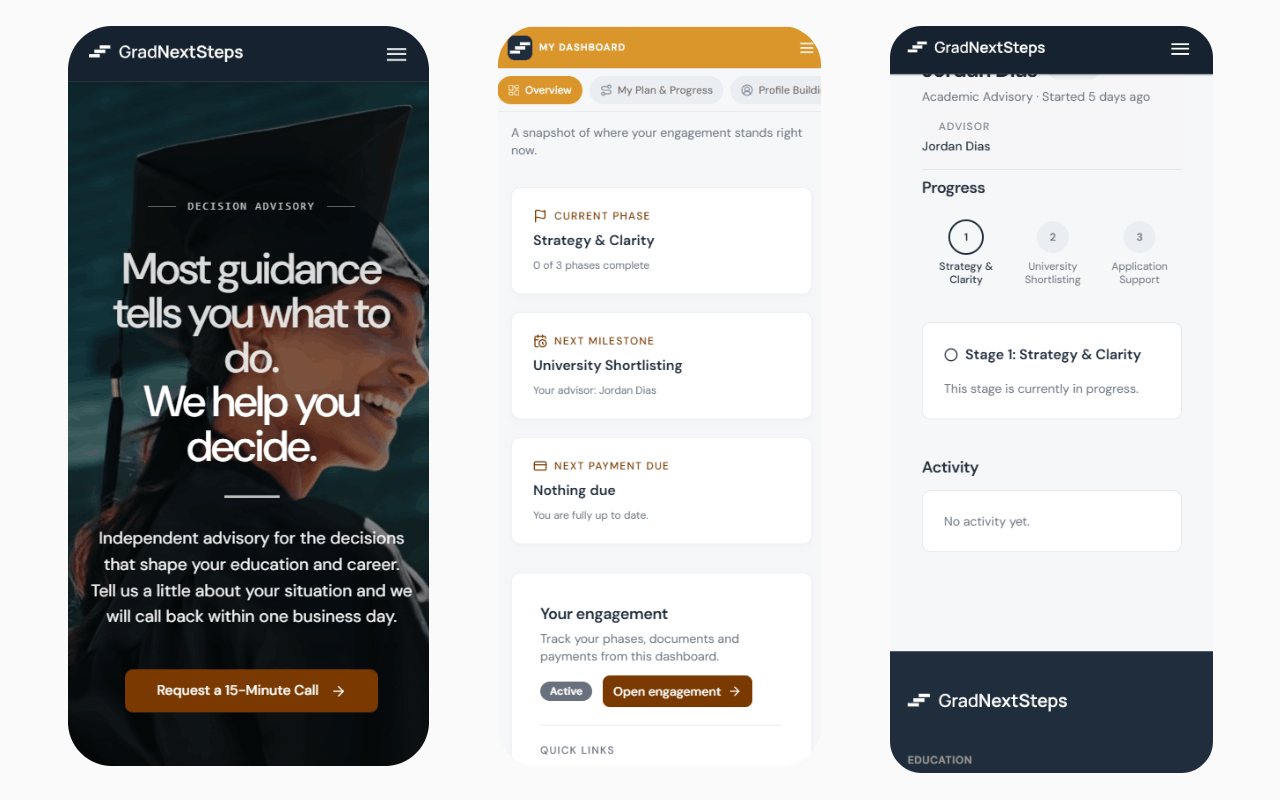
Two connected parts. Self-serve diagnostics generate a structured read and open the relationship: an Aptitude Compass (reasoning, interests and work style, pointing to fields worth exploring) and an Education Pathway Diagnostic (scoring the complexity of an education decision and recommending a path). Human advisory then delivers the plan: an advisor reviews the diagnostic, builds a phased engagement with quarterly milestones, sends a branded proposal, and the client enrolls and pays online and works the plan through a personal dashboard, with mentors tapped where domain depth is needed.
06 · Architecture overview
Structural decisions
The decisions that were expensive to change later, and were therefore made first.
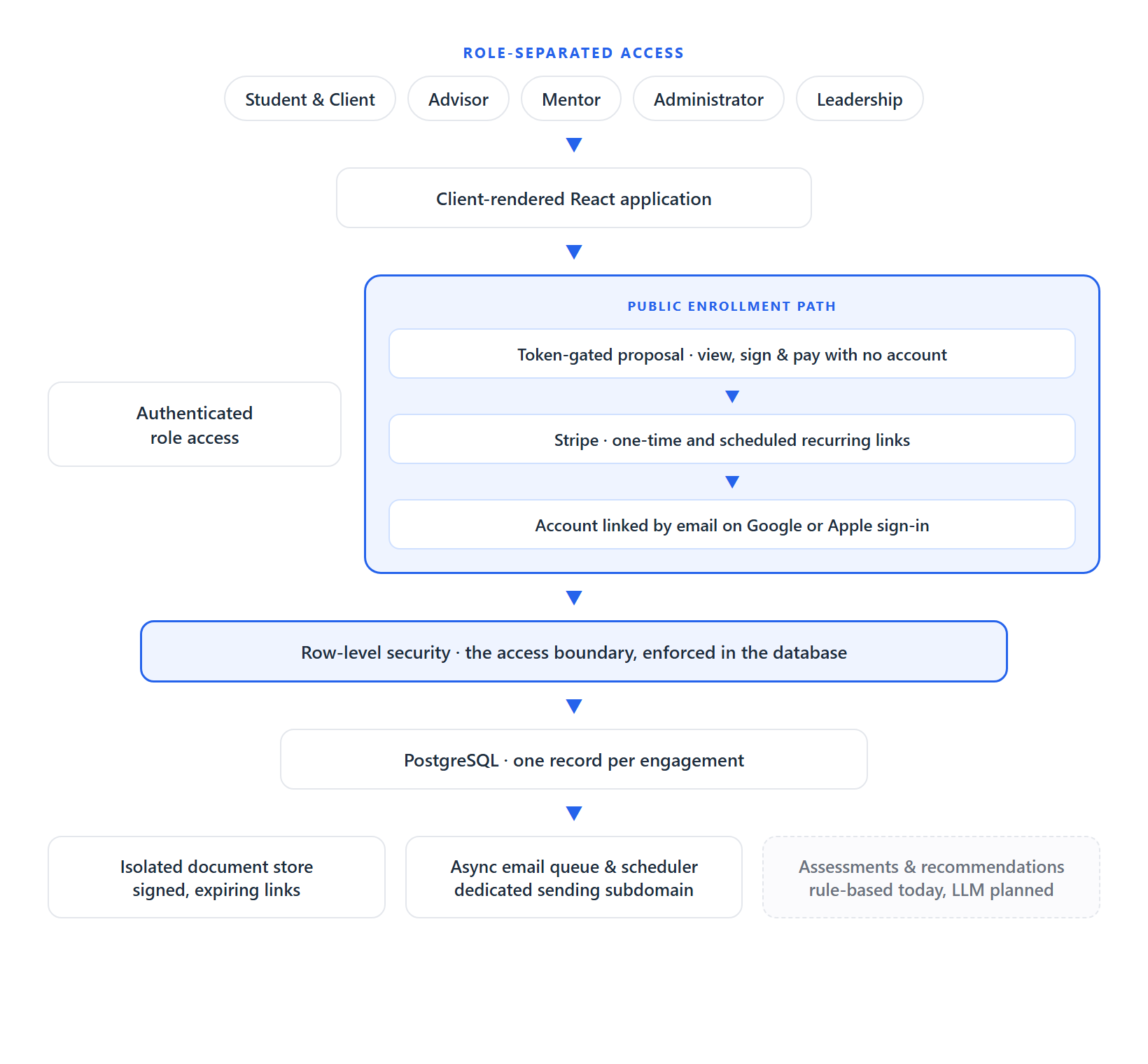
- Access enforced at the database layer through row-level policies, not by the interface, across five roles: student, advisor, mentor, administrator and leadership
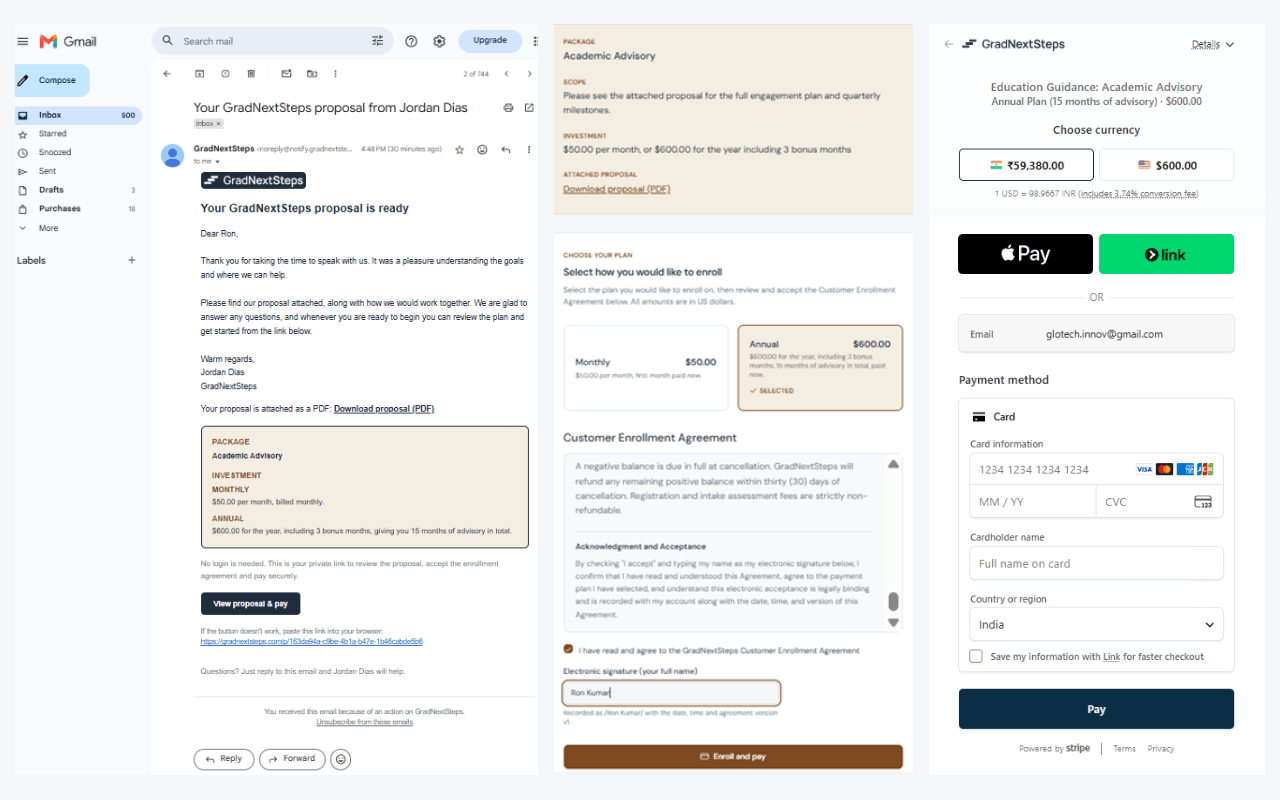
- Token-gated public enrollment: a proposal can be viewed, signed and paid through an unguessable link with no account, then linked to the client's profile by email on sign-in
- Recurring billing without card-on-file auto-debit: scheduled payment links and reminders, chosen to avoid the recurring-payment friction of the primary market rather than block launch on it
- Documents held apart from application data, reachable only through signed, expiring links
- Asynchronous email pipeline on a dedicated sending subdomain, isolating transactional mail from the main domain's reputation
07 · Key features
What the platform actually does
Listed as capabilities that change how work happens, not as a feature inventory.
Aptitude Compass
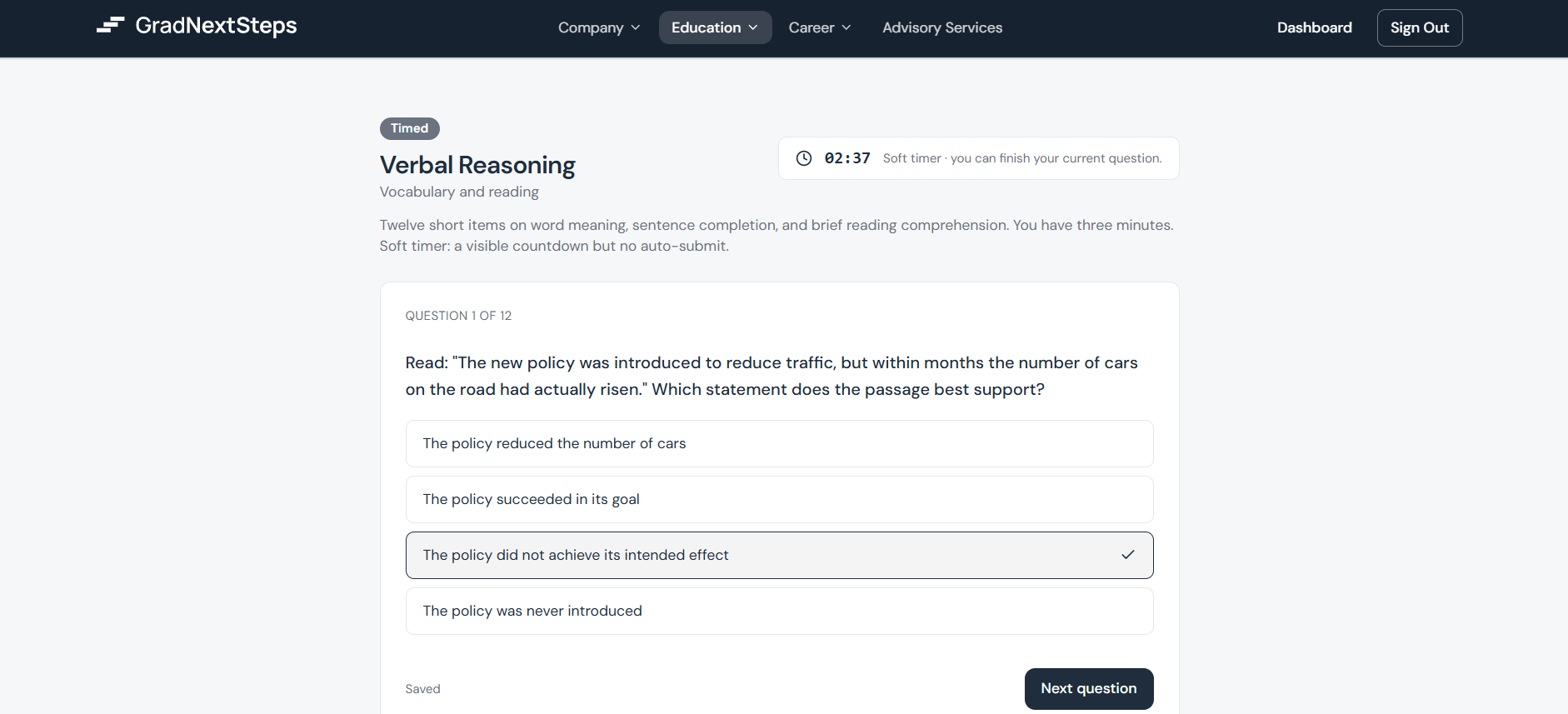
A self-serve aptitude and interests assessment that points to fields worth exploring, labelled beta while its scoring is calibrated.
Education Pathway Diagnostic
A free decision-readiness diagnostic that scores an education decision and recommends how to proceed.
Structured advisory engagements
Phased plans with quarterly milestones, sold as a subscription.
Online enrollment
A branded proposal, plan selection, an electronically signed agreement, and online payment, with no account needed to pay.
Vetted mentor network
With a managed registration and approval flow.
Client dashboard
Subscription and billing, invoices, milestone progress and a profile-building tracker.
Role-separated consoles
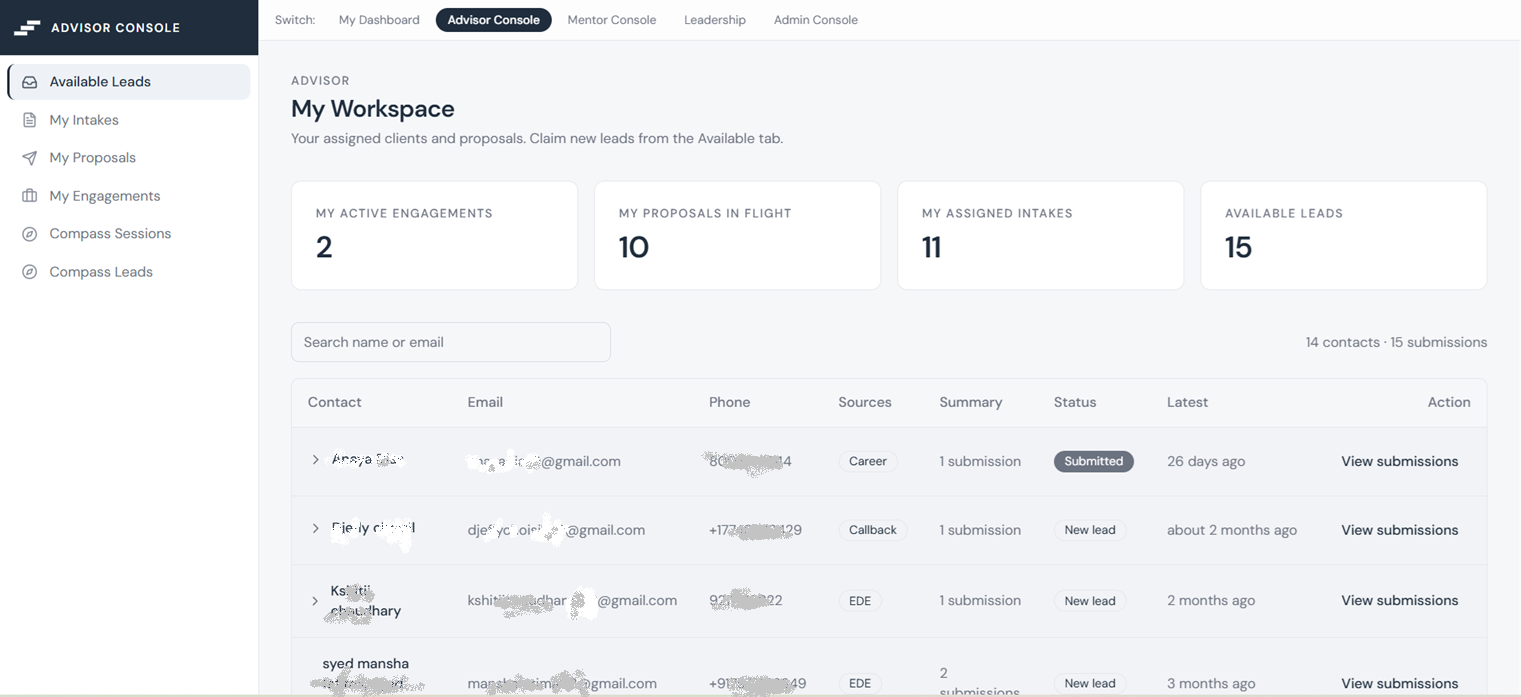
Advisor, mentor, administrator and leadership views over the same record.
08 · Technology stack
What it runs on
Conventional choices, selected so a team other than the one that built it can run and extend it.
- Application
- TypeScript
- React
- Vite (client-rendered single-page app)
- Data
- PostgreSQL with row-level security
- Platform
- Managed Postgres, authentication and edge functions
- Built and shipped on Lovable
- Payments
- Stripe, one-time and scheduled recurring
- Queue-based transactional pipeline on a dedicated sending subdomain
- AI
- Rule-based assessment today
- Language models planned for adaptive testing and report generation
09 · AI usage
Where AI adds value, and where it does not
Deliberately narrow. Today the assessments and their recommendations are rule-based and deterministic, so every result is explainable and defensible while the instruments are still being calibrated. Language models are reserved for two well-scoped roles: adjusting test difficulty in real time once items are calibrated, and turning a validated score profile into a readable, personalised narrative. AI assists the advisory; it never issues a recommendation to a student without human review.
10 · Security and compliance
What was decided before the build
Included because these decisions are difficult and expensive to retrofit.
- Role-level access enforced by database policy, not interface state
- Client documents held apart from application data, reachable only through signed, expiring links
- Electronic enrollment agreement with recorded acceptance: signature, timestamp, version and source
- Consent captured for contact and terms
- Cross-border data handling considered at design time, given an India-first customer base engaging a US entity, with payments and email on established managed providers
11 · Current status
Where it stands today
Live
Live in production at gradnextsteps.com, with the full path operational, diagnostic, advisor proposal, online enrollment and payment, subscription and dashboard, and its first clients moving through it. The measures now tracked are lead-to-proposal conversion, proposal-to-enrollment conversion, and subscription retention.
12 · Lessons learned
What the work taught
Strategic rather than technical: the judgements that carry into the next engagement.
- Honesty about instrument maturity beats overclaiming. Labelling the aptitude tool as beta and keeping its scoring rule-based preserved credibility a premature “AI-validated” claim would have cost.
- Payment design is market-specific. Recurring card auto-debit is hard in the primary market, so scheduled payment links and reminders delivered the subscription model without waiting on it.
- Removing enrollment friction moved the numbers most. Letting a lead view, sign and pay without an account, then linking the account on sign-in, removed the largest drop-off.
Interface
Product views
Reserved for published screenshots. Alt text and captions are in place so the section is meaningful once images are added.
15 · Next evolution
What comes next, and why
Sequenced against business value rather than technical interest.
- Validation and calibration of the aptitude instrument with a psychometrician, unlocking normed scoring and defensible claims
- Adaptive testing and AI-generated personalised reports, once the item bank is calibrated
- Platform-generated proposals that populate the client's milestones automatically, closing the loop between sales and delivery
- Expansion beyond the first market and framework, applying the same structured-advisory model to new regions
The best products begin with the right questions.
Send the business context and the constraint you are working against. I will reply with a direct read on the approach I would take, and whether I am the right person for it.